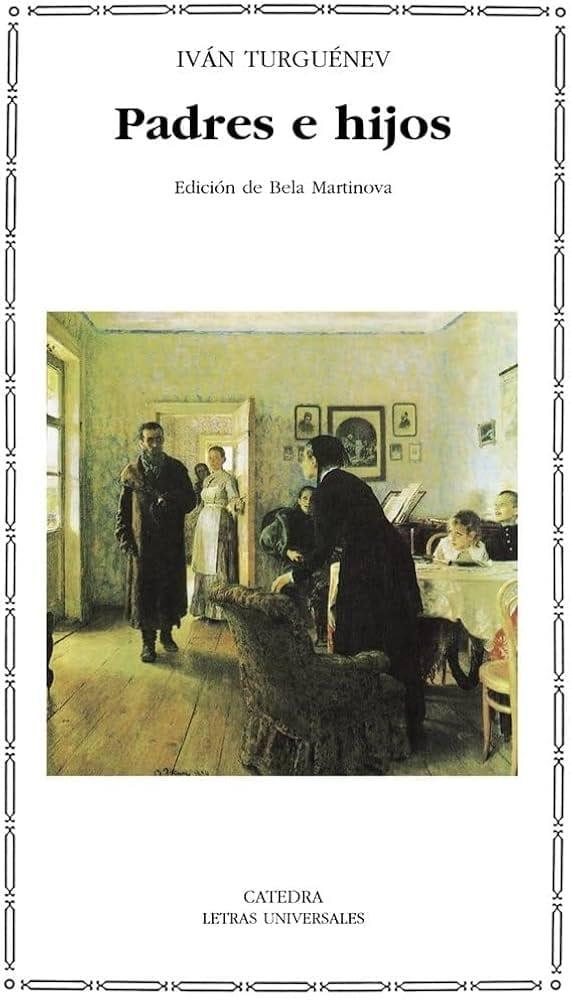
Fathers and Sons
Ivan Turgenev
1862
It is always difficult to turn to the classics, and all the more so when you dare to take on a book by a Russian, Turgenev, from 1862, whose “Fathers and Sons” has a great deal of local colour about it and connects only with difficulty with the style, the message and the evolution of its characters.
But I never stop being surprised by the challenge this book represented. It has the aroma of those books we were forced to read at school, something absolutely out of its time that seemed indigestible to us, but which, with age and many previous readings, turn into genuine virtuosity of period literature, and from which you sense without doubt that this is where everything we now understand as “good literature” comes from.
The story might seem simple, but it isn't. Two friends with very strong characters, both known as the first nihilists, set out on a journey that takes them to three different places. The first, the father of one of them; the second, the family of the other; and the third, a house where a woman of their time lives with her two sisters, all of them unmarried.
On this journey they will question their firmest convictions about politics, honour, religion and philosophy, their friendship, which they considered unbreakable, will be put to the test, and they will come to know the power of love over all the premises they started from.
With exquisite prose (to my taste, at times a little baroque and pompous in its descriptions), a slow rhythm and a story full of chiaroscuro that confronts a way of life with our own, “Fathers and Sons” is an exercise rather than an ordinary read. You have to arm yourself with patience, understand what you're reading in its context and accept that you are going down to the root of literature as entertainment but, above all, as a reflection of a society and a moral code in constant change.
For the erudite.